E-Courses

Upgrade your expertise in EU funding through a comprehensive library of self-paced recorded trainings.
Each e-course provides clear methods, practical tools, templates, and step-by-step guidance to help you navigate proposal development and project management with confidence.
Every e-course includes lifetime access and a live Q&A session to refine your understanding and apply it directly to your work.
Pre-Award Mastery
Pillar I - Excellent Science

- We will familiarise you with the O.W.N. T.H.E. R.O.O.M.™ formula based on the course workbook and live demonstrations by the trainer.
- You will master the O.W.N. T.H.E. R.O.O.M.™ approach for delivering engaging presentations of any context

Crash eCourse based on live recordings in developing successful MSCA Doctoral Networks grant applications. An eye-opening course beyond the standard training. This course is based on step-by-step recipes in order to guide you in detail and how to build each of the different parts of the MSCA DN grant application.
No matter whether you have attended any other trainings on MSCA DN or your experience in it, we personally guarantee you that you will be fully satisfied.
Crash eCourse based on live recordings in developing successful MSCA Doctoral Networks grant applications. An eye-opening course beyond the standard training. This course is based on step-by-step reci…

Crash Course in developing successful MSCA COFUND grant applications. An eye-opening course beyond the standard staff. This course is based on step-by-step recipes in order to guide you in detail and how to build each of the different parts of the MSCA COFUND grant application.
No matter whether you have attended any other trainings on MSCA COFUND or your experience in it, we personally guarantee to you that you will be fully satisfied.
Crash Course in developing successful MSCA COFUND grant applications. An eye-opening course beyond the standard staff. This course is based on step-by-step recipes in order to guide you in detail and …

Crash Course in developing successful MSCA Staff Exchange grant applications. An eye-opening course beyond the standard staff. This course is based on step-by-step recipes in order to guide you in detail and how to build each of the different parts of the MSCA Staff Exchange grant application. There are also successful examples from winning MSCA SE proposals.
Whether you have attended any other training on MSCA Staff Exchange or your experience in it, we guarantee you that you will be fully satisfied.
Crash Course in developing successful MSCA Staff Exchange grant applications. An eye-opening course beyond the standard staff. This course is based on step-by-step recipes in order to guide you in det…

MSCA-PF 2026:How to Win a Postdoctoral Fellowship
EUR 399 million in funding. Around 620 fellowships awarded. A success rate of just 16%. Most MSCA-PF proposals are not rejected because of weak science. They fail because evaluators do not see a convincing match between the researcher, the supervisor, and the host institution. This focused 90-minute webinar shows you exactly what evaluators look for first, what separates 5/5 proposals from rejected ones, and where to spend your final month before the September 2026 deadline. Whether you are preparing your first MSCA-PF application or resubmitting after a previous attempt, this session will help you avoid the structural mistakes that cost excellent researchers funding.
Reserve Your Seat — EUR 50
Why Attend
The MSCA-PF evaluation process rewards clarity, strategic positioning, and institutional fit.
In this webinar, you will learn:
-
How evaluators assess your profile and career stage
-
What “host-institution capacity” really means in scoring
-
The common proposal mistakes that instantly reduce scores
-
How to position European vs Global Fellowships effectively
-
Why many Widening-host applications fail despite strong science
You will leave with a clearer understanding of what evaluators expect — and how to strengthen your proposal before submission.
What You Will Walk Away With
1. Confirm Whether You Have the Right Profile for MSCA-PF
Understand eligibility, experience expectations, and how evaluators interpret researcher maturity.
2. Learn What “Host Capacity” Actually Means
See concrete examples of how host institutions and supervisors are assessed during evaluation.
3. Avoid the 3 Structural Mistakes That Kill Scores
Discover the proposal weaknesses that can drop an application from A to B within minutes.
4. Choose the Right Fellowship Strategy
European vs Global Fellowship, Widening hosts, mobility logic, and narrative positioning explained clearly.
Who Runs the Course
Nikolaos Floratos
EU funding consultant since 2002 and European Commission evaluator with more than 20 years of experience across Horizon 2020, Horizon Europe, and EIC programmes.
-
50,000+ researchers and innovation actors trained
-
Experience across 45+ countries
-
Extensive MSCA-PF evaluation and coaching background
Who Should Attend
This course is designed for:
-
Postdoctoral researchers within 8 years of their PhD
-
Prospective MSCA-PF supervisors
-
University research offices and grants staff
-
Researchers preparing for the September 2026 MSCA-PF deadline
-
Resubmitting applicants seeking stronger evaluation scores
MSCA-PF 2026:How to Win a Postdoctoral Fellowship
EUR 399 million in funding. Around 620 fellowships awarded. A success rate of just 16%. Most MSCA-PF proposals are not rejected because of weak scie…

Develop a Winning MSCA Postdoctoral Fellowship proposal with the support of AI tools -The Success Formula No One Has Told You
What you will learn:
Every year, thousands of postdoctoral researchers apply for the Marie Skłodowska-Curie Postdoctoral Fellowships — but few succeed. The reason? They follow the visible steps, not the hidden strategy.
This half-day expert-led masterclass breaks that pattern. You won’t just learn how to write an MSCA Postdoctoral Fellowship proposal — you’ll learn how to win it.
We’re going beyond general guidelines, webinars/standard trainings, or national contact point briefings. You’ll get:
-
A full breakdown of what reviewers really look for
-
The invisible structure of successful proposals and how to built each section
-
Real-world examples, do’s and don’ts, and reviewer red flags
-
The secret to positioning yourself and your host institution as the perfect match
-
Templates and prompts that cut writing time in half
-
A full and detailed pre-evaluation of your full Proposal
UNIQUE BONUSES
-
Bonus 1: Lifetime access to the video recordings and the training content
-
Bonus 2: Monthly Live Q&A sessions (Even if not available on Nov 11, you still can watch the recordings and join the live Q&A sessions.)
-
Bonus 3: 100% Satisfaction Guarantee (Else we return your money back. That confident we are about its value)
-
Bonus 4: You get detailed pre-evaluation of your full proposal by an MSCA Expert
Develop a Winning MSCA Postdoctoral Fellowship proposal with the support of AI tools -The Success Formula No One Has Told You
What you will learn:
Every year, thousands of postdoctoral researchers…
The Full Recipe for Developing Successful ERC Grant Applications — 2027
Summary
This practical ERC proposal development course takes researchers through the full process of preparing a competitive ERC grant application, from understanding the ERC landscape and 2027 rules to developing a compelling research idea and presenting it effectively to evaluators.
Led by Nikolaos Floratos, the training combines ERC intelligence, proposal-development frameworks, evaluator insights, real evaluation examples and practical guidance for developing both B1 and B2. Particular attention is given to what makes an ERC proposal appear genuinely breakthrough and ground-breaking, how generalist and specialist evaluators read the proposal, and how researchers can demonstrate scientific excellence, independence, creativity and leadership.
The course also addresses the major changes introduced in the ERC Work Programme 2027, including eligibility windows, application restrictions, grant schemes, evaluation procedures, panel selection and the role of keywords in the selection of external referees.
Rather than treating proposal writing as simply filling in a template, the course presents it as a structured development process: understand the ERC, build the right research idea, develop the proposal strategically, and communicate its value clearly to evaluators.
What You Will Learn
How the ERC works and what it looks for in frontier research proposals.
The key changes, eligibility rules, deadlines, grant schemes and restrictions introduced in the ERC Work Programme 2027.
How ERC proposals are evaluated at Step 1 and Step 2 and how panel members and external reviewers interact with the proposal.
How to use ERC Work Programme documents, Information for Applicants, evaluator guides, statistics, previous projects and panel information as sources of proposal intelligence.
How to distinguish a breakthrough research idea from ground-breaking objectives and avoid incremental research.
How to demonstrate scientific excellence, including novelty, importance, impact, interdisciplinarity and feasibility.
How to demonstrate the Principal Investigator's independence, creativity, research achievements and leadership.
How to select the appropriate primary ERC panel and use free-text keywords strategically.
How to structure B1 for generalist evaluators and develop B2 for more specialised evaluation.
How to develop a strong proposal storyline using frameworks such as VPS, POWER and CARTIO.
How to formulate a clear abstract that answers the four key questions: why this project, why now, why this way, and why you.
How to use figures, diagrams, tables and other visual elements to make complex research understandable.
How to use AI tools appropriately while respecting ERC requirements concerning authorship, plagiarism, confidentiality and responsible use.
How to plan the proposal development process backwards from the submission deadline and incorporate external feedback and evaluation.
Course Approach
The course follows a practical, step-by-step "recipe" for ERC proposal development built around three core stages:
1. ERC Intelligence
Understand the ERC before writing: its purpose, grant schemes, eligibility, evaluation criteria, panels, keywords, statistics, successful projects and key official documents.
2. I.C.R.E.A.T.E.™ Proposal Development System
Follow a structured process for turning a research idea into a coherent ERC proposal, including defining the research challenge, objectives, approach and overall proposal storyline.
3. C.R.I.T.E.R.I.A.™ Formula
Learn how to present the proposal in a way that addresses the aspects evaluators look for, with particular attention to scientific excellence, breakthrough potential, independence, creativity, leadership and impact.
The training combines explanations, practical frameworks, examples drawn from proposal evaluations and concrete recommendations that researchers can apply during their own proposal development.
The accompanying training materials are designed not only to support the course itself but also to serve as a reference manual that researchers can return to throughout the ERC proposal-development cycle.
Who Is It For?
This course is designed for researchers preparing, considering or developing an ERC grant application, including applicants for:
ERC Starting Grant
ERC Consolidator Grant
ERC Advanced Grant
ERC Synergy Grant
ERC Plus Grant
It is suitable for both researchers who are new to ERC proposals and experienced applicants who want to strengthen their proposal-development strategy and better understand the evaluator perspective.
It can also be useful for research managers, proposal-support professionals and others involved in supporting researchers through the ERC application process.
What You Will Take Away
By the end of the course, you will have a clearer roadmap for developing your ERC proposal and a set of practical tools to guide the process.
You will take away:
A structured understanding of the ERC 2027 funding landscape and evaluation process.
Practical frameworks for developing and positioning your research idea.
Guidance for developing a strong B1 and B2.
A strategy for researching successful ERC projects and gathering relevant ERC intelligence.
Tools for defining your proposal's challenge, objectives, activities, results and impacts.
Guidance on demonstrating your independence, creativity and leadership through your track record.
A clearer approach to selecting your panel and keywords.
Practical recommendations for writing for both generalist and specialist evaluators.
A proposal-development timeline that encourages early preparation, collaboration and external feedback.
Examples of common weaknesses identified through ERC evaluations and ways to address them.
Training materials that can be used as a practical reference throughout your ERC proposal-development cycle.
Who Runs It?
The course is led by Nikolaos Floratos, founder of Funding Expert Academy and an experienced European research funding trainer, coach and evaluator.
Nikolaos has been active in the European research funding field since 1997 and has worked as an European Commission expert/evaluator since 2003. He has trained and coached researchers and organisations across Europe and specialises in breaking down complex European funding processes into practical, step-by-step approaches.
His training combines perspectives from the applicant, evaluator and trainer sides of European research funding, with a particular focus on helping researchers understand not only what the ERC documents say, but how proposals are actually developed and read during evaluation.
The Full Recipe for Developing Successful ERC Grant Applications — 2027
Summary
This practical ERC proposal development course takes researchers through the full process of preparing a competitive ERC g…
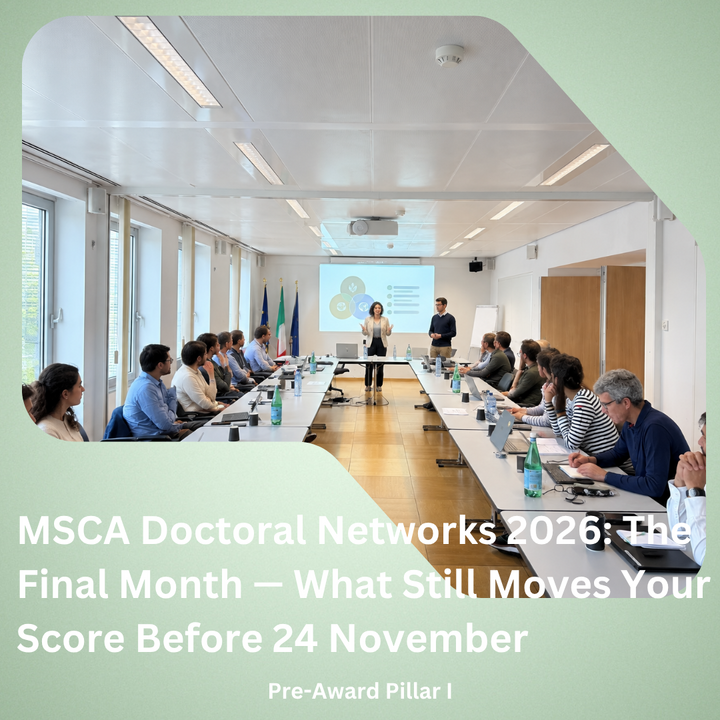
Recorded e-Course | Marie Skłodowska-Curie Actions (MSCA) Doctoral Networks 2026
Prepare your MSCA Doctoral Networks 2026 proposal for the final submission stage with practical, evaluator-focused guidance from Dr. Nikolaos Floratos, an experienced European Commission expert evaluator.
Based on the live webinar, The Final Month: What Still Moves Your Score Before 24 November, this recorded e-course explains how to identify and address common proposal shortcomings that can cost valuable evaluation points. With the MSCA DN 2026 deadline approaching, discover how to strengthen your proposal's Excellence, Impact and Implementation sections through targeted improvements, clear evidence and careful consistency checks.
What you will learn:
-
Understand the 2026 call changes: Review key updates affecting eligibility, evaluation thresholds, secondments, formatting and the application process.
-
Strengthen your Excellence section: Audit mandatory template subheadings, sharpen research objectives, define measurable KPIs and demonstrate scientific ambition and integration between doctoral candidate projects.
-
Improve your training and supervision plans: Make network-wide training activities concrete, clarify supervisory responsibilities and demonstrate the contribution of academic and non-academic partners.
-
Make your Impact section convincing: Define measurable career outcomes, demonstrate non-academic sector involvement, strengthen dissemination and exploitation plans, and explain the magnitude and importance of expected impacts.
-
Build a credible Implementation plan: Align work packages, deliverables, milestones, risks, person-months and doctoral candidate projects across the application.
-
Avoid common evaluation shortcomings: Learn how evaluators assess proposals and identify vague claims, missing information, inconsistent figures and formatting errors before submission.
-
Apply a final-month checklist: Prioritise practical improvements that can make your proposal clearer, more consistent and more competitive.
Who should take this course?
This recorded e-course is designed for MSCA Doctoral Networks 2026 coordinators, proposal writers, research managers, university support teams and consortium partners preparing or reviewing an application for the 24 November 2026 deadline.
Your trainer: Dr. Nikolaos Floratos
Dr. Nikolaos Floratos has been a European Commission expert evaluator since 2003, covering MSCA, Cluster calls, the EIC and Widening. He is the founder of Funding Expert Academy and the OpenCosmos community platform.
Learn at your own pace
Access the recorded session and revisit the practical recommendations as you refine your MSCA Doctoral Networks proposal. Use the guidance to identify weaknesses, prioritise final improvements and prepare a more coherent, evaluator-ready application.
Please note: This course provides practical proposal-development guidance. It does not guarantee funding or a successful evaluation.
Questions?
Email info@keyinnovations.eu
Recorded e-Course | Marie Skłodowska-Curie Actions (MSCA) Doctoral Networks 2026
Prepare your MSCA Doctoral Networks 2026 proposal for the final submission stage with practical, evaluator-focused gui…
Pillar II - Global Challenges and European Industrial Competitiveness

Crash eCourse based on live recordings in understanding how an Horizon Europe grant application is evaluated based on each of the formal and informal success award criteria and what you should do in order to give proper feedback as a pre-evaluator of a proposal or what you should do as an applicant in order to increase significantly the quality of each of the three technical description sections of your application.
This is a unique training as never offered based on 19 years of experience as an Evaluator on behalf of the European Commission. We personally guarantee you that you will be fully satisfied.
The structure is as follows:
-
Module 1: Evaluation Intelligence
- What evaluators know, think and expect
- How evaluators are impressed in general
from an Horizon Europe Proposal
-
Module 2 : Intelligence on Excellence and Implementation sections
- How the Excellence section should be evaluated
- How evaluators are impressed from the Excellence section
- How the Implementation section should be evaluated
- How evaluators are impressed from the Implementation section
-
Module 3 : Intelligence on Impact section
- How the Impact sections should be evaluated
- How evaluators are impressed from the Impact section
Crash eCourse based on live recordings in understanding how an Horizon Europe grant application is evaluated based on each of the formal and informal success award criteria and what you should do in o…

Crash Course in Horizon Europe proposal Writing: a focused step-by-step training to turn complexity into clarity. An eye opening experience that goes far beyond standard grant writing workshops.

Artificial Intelligence tools and practices for successful grant writing in Horizon Europe with focus on RIA and IA actions. Updated April 2025 with the latest developments and hands on practice. Full day!
Interested in organizing this training on-site for your team or institution?
Contact us at info@keyinnovations.co.uk for more details and availability.
Artificial Intelligence tools and practices for successful grant writing in Horizon Europe with focus on RIA and IA actions. Updated April 2025 with the latest developments and hands on practice. Full…
A crash e-course with live Q&A session on how to create winning Horizon Europe grant applications before anyone else. (There is a way).
Access to step-by-step the training material and the live recordings (~13 hours)
Pillar III - Innovative Europe

Through this recorded training program, you will learn how to master key aspects of proposal writing, build impactful consortia, and utilize effective evaluation methods to ensure your project stands out. The course covers techniques for building strong profiles, engaging with key actors, and providing compelling references—crucial elements for success in both EIC Pathfinder Challenges and Transition Open calls.
Whether you are a newcomer to Horizon Europe or seeking to enhance your competitive edge, this eCourse offers essential guidance to help you unlock future opportunities in groundbreaking and high-risk projects. Don’t miss this chance to develop the expertise needed for successful applications and become a key player in Europe’s innovation ecosystem.
Enroll today and start your journey to mastering EIC Pathfinder Challenges and Transition Open funding success!
Through this recorded training program, you will learn how to master key aspects of proposal writing, build impactful consortia, and utilize effective evaluation methods to ensure your project stands …
Widenning Participation & Strengthening the European Research Area

The TEAMING course takes place live on 14th Sept from 09:30 till 16:30 CEST. In this course you will master one of the most popular funding opportunities and learn how to build a successful proposal for the
- Creation of new centres of excellence or upgrading the existing ones in low R&I performing countries, and
- Building on partnerships between leading scientific institutions in Europe and the main beneficiary institutions in low R&I performing countries that display the willingness to engage together for this purpose
The WIDENING/TEAMING call invites as coordinators research institutes, universities and regional/public authorities from widening countries, i.e. less advanced countries. According to the Horizon Europe regulation in this programme component the less advanced countries eligible for hosting the co-ordinator of widening actions are Bulgaria, Croatia, Cyprus, Czechia, Estonia, Greece, Hungary, Latvia, Lithuania, Malta, Poland, Portugal, Romania, Slovakia, Slovenia and all Associated Countries with equivalent characteristics in terms of R&I performance and the Outermost Regions.
The TEAMING course takes place live on 14th Sept from 09:30 till 16:30 CEST. In this course you will master one of the most popular funding opportunities and learn how to build a successful proposal f…

Further to the big success of our previous live training on AI where we gave focus on RIA/IA type of actions, this time we organize a second workshop with focus on CSA (Coordination Support Actions) as well as to Cascade Funding/Financial Support to Third Parties. For this, we will work on Excellence Hubs and create with AI each of the parts in the grant application and compare them with winning sections/extracts from previous successful proposals under Excellence Hubs.
Further to the big success of our previous live training on AI where we gave focus on RIA/IA type of actions, this time we organize a second workshop with focus on CSA (Coordination Support Actions) …

This course is for researchers from organizations based in Widening countries. In this course, you we will get familiar with
- the intelligence behind the current open calls in Twinning under Horizon Europe
- How to write step-by-step each of the three sections in the grant application (Excellence, Impact, Implementation) and impress te evaluators
- How to deal with the lump-sum budget requirement in Twinning actions.
Fully practical and beyond the info that you can find in any other events or trainings.
100% satisfaction guarantee! We are so confident of the value of this training that in case you are not satisfied, we will reimburse any training fee you have paid.
This course is for researchers from organizations based in Widening countries. In this course, you we will get familiar with
- the intelligence behind the current open calls in Twinning under Horizon…

Hop-on Facility Success 2026
86 funded Horizon Europe projects are currently eligible to add a new Widening-country partner.
Most universities, research institutes, and SMEs in Widening countries spend months preparing full proposals when they could instead join an already-funded consortium through the Hop-on Facility.
The problem is not eligibility.
The problem is knowing which projects fit, how to assess your chances, and how to approach coordinators in a way that gets a response.
This practical 60-minute webinar shows you exactly how to do that.
By the end of the session, you will know how to identify suitable projects, verify your eligibility, understand what evaluators look for, and make first contact with coordinators running funded Horizon Europe projects.
No prior Hop-on experience required.
Reserve My Seat — EUR 50
Why Attend
There are currently 86 funded projects eligible for Hop-on participation.
Many Widening-country organisations never apply because they assume:
- The process is complicated
- Coordinators are not interested
- They need existing consortium contacts
- The opportunity is highly competitive
Most of these assumptions are wrong.
Hop-on was specifically designed to bring new Widening-country organisations into funded Horizon Europe projects.
This session shows you:
- Which projects are available right now
- Whether your organisation qualifies
- How coordinators decide who to bring on board
- How the evaluation process works
- What first contact messages actually get replies
You leave with a practical action plan rather than general information.
What You Will Learn
1. What the Hop-on Facility Actually Is
Understand the purpose of the scheme, why it exists, who it was designed for, and why the current call represents a significant opportunity for Widening-country organisations.
2. How to Check Eligibility in Minutes
Learn the key eligibility rules including:
- Eligible Widening countries
- Associated Countries and Outermost Regions
- Project eligibility requirements
- RIA-only restrictions
- Timing requirements
- Consortium limitations
By the end of this section you will know whether your organisation can participate.
3. How to Find the Right Project Among the 86 Eligible Opportunities
Learn how to:
- Navigate the eligible-project list
- Read CORDIS project records
- Analyse work packages
- Identify genuine strategic fit
Including a live walkthrough of real eligible projects.
4. What Evaluators Actually Score
Understand:
- Why the existing project is not re-evaluated
- What "R&I added value" means
- How excellence is assessed
- What makes a strong Hop-on application
This section focuses on the criteria that determine success.
5. How to Convince a Coordinator to Say Yes
Most organisations focus on what they want.
Successful applicants focus on what the coordinator gains.
Learn:
- Why coordinators accept new partners
- When to make contact
- How timing affects success
- The structure of a first outreach message that gets attention
6. Common Myths That Waste Time
Directly from the official guidance and FAQs:
- Page limits explained
- Why "stand-by partner" strategies fail
- Consortium restrictions
- What is and is not reassessed
Avoid mistakes that eliminate applications before they start.
Who Runs the Course
Nikolaos Floratos
EU funding consultant since 2002 and European Commission evaluator with more than 20 years of experience across Horizon 2020, Horizon Europe and EIC.
- 50,000+ researchers and innovation actors trained
- Experience across 45+ countries
- Extensive Horizon Europe evaluation and consortium-building experience
Who Should Attend
This course is designed for:
- Universities in Widening countries
- Research institutes
- SMEs
- Technology organisations
- Research managers
- Grant offices
- Innovation agencies
- Organisations seeking entry into Horizon Europe consortia
Hop-on Facility Success 2026
86 funded Horizon Europe projects are currently eligible to add a new Widening-country partner.
Most universities, research institutes, and SMEs in Widening countries sp…
Erasmus +

In this Course, no matter what is your experience in European Funding Programmes related to education, in this day you will master the following for Erasmus Plus:
- How to create a great idea for a specific call in Erasmus Plus
- Whom to connect with for getting feedback on your idea
- Pitfalls and musts that you should know related to your targeted call topic
- How to build a proposal summary that rocks related to your proposal idea
- How to attract the best partners on board
- How to identify and join competitive consortia related to your targeted call topic
- How to build the main elements of a proposal and impress the evaluators
Extra Bonuses:
- Follow-up live Q&A within a month after your participation for clarifying any issues or addressing any of your personal challenges in project managemet
- Certificate of successful attendance for all participants that participate live on the day that course takes place or watched all the videos based on the course logfiles
In this Course, no matter what is your experience in European Funding Programmes related to education, in this day you will master the following for Erasmus Plus:
- How to create a great idea for a spec…
Post-award Mastery
Management of EU Funded Projects

Step-by-step strategies for mastering Financial Management, budgeting and EC auditing of EU funded projects (FM-Open)
Master the strategies for rejection-free claimed costs in EU projects and an audit-proof approach

In this eCourse based on live recordings on on Innovation Management of EU funded Research and Innovation Projects and in one day, you will master the concept and purpose of Innovation Management in European Research and Innovation projects. This concept includes a whole spectrum of 10 different strategies for fulfilling the vision of any Research Project, i.e. to create impact and benefits to society and industry such as creating forefront knowledge, advancing growth and improving quality of life.
Extra Bonuses:
- Full access to all the recordings after the training for watching any points that you wish to master more
- Follow-up live Q&A within a month after your participation for clarifying any issues or addressing any of your personal challenges in project managemet
- Certificate of successful attendance for all participants that participate live on the day that course takes place watched all the videos based on the course logfiles
The course structure consists of the following modules:
-
Module 1: Think and Act like an Innovator based on the B.U.N.D.L.E.R® habits
-
Module 2: S.E.L.F.I.S.H. P.A.C.K.™: Strategies for Innovation Management (Use Case Validation, Dissemination & Exploitation, Market Analysis & Surveillance, Technology transfer incl. IPR, Impact Assessment, Standardisation, Policy Influence, Industrialisation/Commercialisation, Revenue Generation)
- Module 3: Creativity Intelligence: Design & Creativity of breakthrough ideas
In this eCourse based on live recordings on on Innovation Management of EU funded Research and Innovation Projects and in one day, you will master the concept and purpose of Innovation Management in E…

Our live eCourse on EU funds is a live training beyond on what is currently available on public guides and includes key topics based on examples, previously submitted proposals, successful implementation of EU funded projects and step-by-step guidance
General & Other Courses
Soft Skills for Planning and Management of EU Funded Projects

Speed reading methods and techniques for doubling your pace in reading and understanding key documents related to European Research (Proposals, supporting material, infoday material, deliverables, etc)

Unlock the secrets to successful negotiations in the complex landscape of European funded projects with our comprehensive course.

Identify which are bad habits for you and master techniques on how to replace them with good ones and live your life as a champion in five areas (Profession, Education, Health, Relationships and Lifestyle).
Fully practical based on the latest techniques for quitting smoking up to becoming the best innovator.
Identify which are bad habits for you and master techniques on how to replace them with good ones and live your life as a champion in five areas (Profession, Education, Health, Relationships and Lifes…
Impact & Social Sciences and Humanities

The course "How to Be Successful in Horizon Europe from the Social Sciences and Humanities fields" provides participants with practical guidance on leveraging funding opportunities within Horizon Europe. This comprehensive training emphasizes the role of social sciences and humanities in EU research priorities, covering essential frameworks like Technology Readiness Levels (TRL) and Societal Readiness Levels (SRL) to assess project maturity and societal impact. Participants will learn to identify suitable calls, engage with partners, and understand project impacts, as well as gain insights into proposal-building for Cluster 2. The course offers hands-on steps for finding calls, understanding expected outcomes, and successfully integrating social science and humanities expertise into Horizon Europe projects.
The course "How to Be Successful in Horizon Europe from the Social Sciences and Humanities fields" provides participants with practical guidance on leveraging funding opportunities within Horizon Euro…

Master the new requirements on Impact in Horizon Europe as well as techniques and tips for impressing with your Impact section in a Horizon Europe grant application
You will master the following:
-
Module 1: Impact Intelligence in Horizon Europe: Master public resources related to Impact in Horizon Europe and exploit them to your advantage
-
Module 2: Impact Strategies in Horizon Europe: Action plans (Tips and best practices) related to the expected impacts in Horizon Europe workprogrammes
- Module 3: How to impress evaluators with your Impact section in the proposal grant application of Horizon Europe: Examples and templates aligned with the norms and expectations from the Impact section in the grant application
Master the new requirements on Impact in Horizon Europe as well as techniques and tips for impressing with your Impact section in a Horizon Europe grant application
You will master the following:
-
…
Other EU Funding Programmes

Training will focus on three main areas: Digital Europe Intelligence, Profile Intelligence, and Communication Intelligence.
Updated June 2025 with the latest developments and hands on practice. Full day!
People Also Ask
Is there a certificate of completion?
Yes, participants who complete the training can receive a Certificate of Completion from Funding Expert Academy. After finishing the course, you can request your certificate through a dedicated call-to-action available within the platform.
How long do I have access to the course materials?
You will have lifetime access to the course materials, allowing you to learn at your own pace and return to lessons, templates, and resources whenever needed. This is especially useful when working on real EU funding proposals and needing a quick refresher.
Are the course materials updated for Horizon Europe?
Yes, you can post questions directly within the course platform. Our team, along with Nikolaos Floratos, reviews these queries and provides guidance to help you better understand the practical aspects of EU funding, Horizon Europe, Erasmus+, and proposal development. You can also join the dedicated Q&A session held on the first Wednesday of every month to ask questions and receive practical guidance directly from Nikolaos.
Is there support if I have questions about a lesson?
Yes, you can post questions directly within the course platform. Our team, along with Nikolaos Floratos, reviews these queries and provides guidance to help you better understand the practical aspects of EU funding, Horizon Europe, Erasmus+, and proposal development. You can also join the dedicated Q&A session held on the first Wednesday of every month to ask questions and receive practical guidance directly from Nikolaos.
Copyright © 2025 Key Innovations Cyprus Ltd · EVAGOROU 31, EVAGORAS COMPLEX, 2nd floor, office 24 · 1068 Nicosia · Cyprus